


Households across the country are constantly searching for ways to reduce their energy consumption without sacrificing comfort. One surprisingly effective yet often overlooked solution lies right above your head: the humble ceiling fan. While most people associate these fixtures with summer cooling, a simple adjustment can transform them into powerful allies during the colder months. By reversing the direction of your ceiling fan blades, you can redistribute warm air that naturally rises to the ceiling, pushing it back down into your living space. This straightforward technique can significantly reduce your reliance on central heating systems, leading to noticeable savings on your energy bills whilst maintaining a comfortable indoor environment throughout winter.
Understanding how a ceiling fan works
The basic mechanics of air circulation
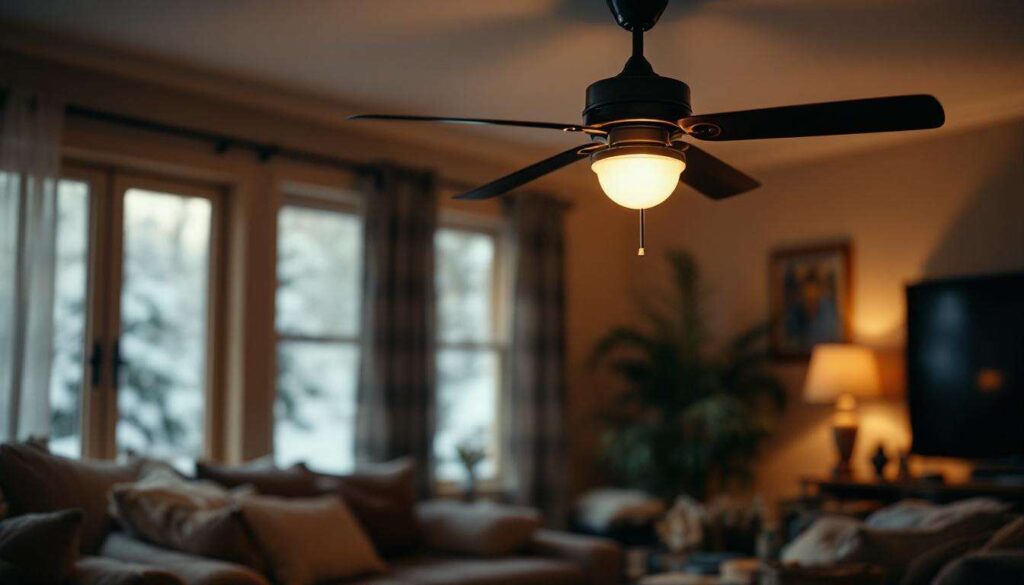
Ceiling fans operate on a relatively simple principle: rotating blades move air throughout a room, creating circulation patterns that affect how we perceive temperature. The fan motor drives the blades in either a clockwise or anticlockwise direction, depending on the setting selected. Most modern ceiling fans feature a small switch, typically located on the motor housing, that allows users to reverse the rotation direction. This seemingly minor adjustment fundamentally changes the airflow pattern and the fan’s impact on room temperature.
Directional airflow and its effects
When ceiling fan blades rotate anticlockwise (the standard summer setting), they push air directly downward, creating a cooling breeze effect. This wind chill effect makes occupants feel cooler without actually lowering the room temperature. Conversely, when blades rotate clockwise at a low speed, they pull air upward along the fan’s axis and push it outward along the ceiling before it gently descends along the walls. This creates a subtle circulation pattern that redistributes warm air without creating an uncomfortable draft.
Understanding these fundamental mechanics helps homeowners appreciate why a simple directional change can have such a profound impact on heating efficiency. The key lies in working with, rather than against, the natural behaviour of warm and cool air within enclosed spaces.
Why reverse the blades in winter ?
The science of heat stratification
Warm air is less dense than cool air, causing it to rise naturally towards the ceiling in any heated room. This phenomenon, known as thermal stratification, means that the warmest air in your home often accumulates in the least useful location: several feet above your head. Meanwhile, the floor level where you actually spend your time remains cooler, prompting you to increase the thermostat setting. By reversing your ceiling fan to rotate clockwise, you can counteract this wasteful heat distribution.
Redistributing warmth effectively
The clockwise rotation creates an updraft that draws room air upward, forcing the accumulated warm air near the ceiling to move outward and down the walls. This gentle redistribution brings that trapped warmth back to the occupied zones of your room without creating the direct breeze that would make you feel colder. The process works continuously and passively, requiring only the minimal energy needed to run the fan motor, which is considerably less than the energy required to generate additional heat.
- Reduces temperature differential between ceiling and floor
- Maintains consistent warmth throughout the room
- Eliminates cold spots near windows and exterior walls
- Allows lower thermostat settings whilst maintaining comfort
This understanding of thermal dynamics reveals why this simple adjustment can make such a substantial difference to both comfort and energy consumption during the heating season.
The energy benefits in the winter months
Quantifying potential savings
Research indicates that using ceiling fans in reverse mode during winter can reduce heating costs by approximately 10 to 15 per cent. The exact savings depend on various factors including room size, ceiling height, insulation quality, and local climate conditions. Homes with particularly high ceilings benefit most dramatically, as these spaces experience the greatest degree of heat stratification.
| Ceiling Height | Estimated Annual Savings | Payback Period |
|---|---|---|
| Standard (2.4-2.7m) | £40-£60 | 1-2 heating seasons |
| High (3-4m) | £80-£120 | Less than 1 season |
| Very High (4m+) | £120-£180 | Immediate |
Comparative energy consumption
A typical ceiling fan consumes between 15 and 90 watts depending on size and speed setting. Running a fan on low speed for eight hours daily throughout a four-month winter period uses approximately 14-56 kilowatt-hours of electricity. At current energy prices, this translates to roughly £5-£20 for the entire winter. Meanwhile, the reduced thermostat requirement saves considerably more, as heating systems consume hundreds or thousands of watts continuously. Even a modest one-degree reduction in thermostat setting can offset the fan’s energy consumption many times over.
These tangible financial benefits make ceiling fan reversal one of the most cost-effective energy-saving measures available to homeowners, requiring no installation costs if fans are already present.
How to adjust your fan for optimal comfort
Locating and using the reverse switch
Most ceiling fans manufactured in recent decades include a small slide switch on the motor housing that controls blade direction. To safely change the setting, first turn off the fan completely and wait for the blades to stop moving entirely. Locate the switch, which may be labelled with directional arrows or simply marked as a reverse switch. Slide it to the opposite position, then restart the fan at the lowest speed setting to verify the direction change.
Selecting the appropriate speed
Unlike summer operation where higher speeds create more cooling effect, winter operation requires only the lowest speed setting. The goal is gentle circulation rather than perceptible airflow. Higher speeds can create drafts that make occupants feel colder despite redistributing warm air. Start with the lowest setting and only increase slightly if you notice no improvement in temperature distribution after several hours of operation.
- Always use the lowest speed setting initially
- Run the fan continuously rather than intermittently
- Adjust only after observing effects for at least 24 hours
- Consider room size when determining optimal speed
Timing and operational strategies
For maximum efficiency, run your reversed ceiling fan whenever the heating system is active. Many homeowners choose to operate fans continuously throughout winter, as the minimal energy consumption is offset by consistent heat distribution. In rooms with programmable thermostats, coordinate fan operation with heating schedules to maximise the redistribution effect during occupied hours.
Proper adjustment ensures you gain the full benefit of this technique whilst maintaining the comfortable environment you desire during cold weather.
Common mistakes to avoid when using the fan in winter
Running the fan at excessive speeds
The most frequent error is operating the fan at medium or high speeds during winter months. This creates a noticeable downward airflow that produces a wind chill effect, making occupants feel colder despite the warm air circulation. The sensation of moving air against skin triggers the body’s cooling response, counteracting the very benefit you’re trying to achieve. Remember that winter operation requires only gentle circulation at the lowest possible speed.
Forgetting to reverse direction
Many people simply leave their fans set to the summer anticlockwise direction year-round. This actively works against winter heating efforts by creating cooling breezes and failing to address heat stratification. The directional setting makes all the difference between an energy-saving tool and an energy-wasting liability during cold months.
Neglecting fan maintenance
Dust accumulation on blades reduces efficiency and can cause wobbling that damages the motor over time. Clean blades regularly to maintain optimal performance. Additionally, check that mounting hardware remains tight, as vibration can loosen connections. A well-maintained fan operates more quietly and efficiently, encouraging consistent use throughout the heating season.
- Never run fans at high speed during winter
- Always verify clockwise rotation before winter operation
- Clean blades at the start of each heating season
- Check mounting stability to prevent motor damage
- Ensure adequate clearance between blades and ceiling
Avoiding these common pitfalls ensures your ceiling fan functions as an effective heating supplement rather than an impediment to comfort.
Comparison with other energy-saving methods
Cost-effectiveness relative to alternatives
When compared to other energy-saving strategies, ceiling fan reversal offers exceptional value. Installing additional insulation costs hundreds or thousands of pounds, whilst upgrading to a high-efficiency heating system represents a major capital investment. By contrast, using existing ceiling fans in reverse mode requires zero initial investment and minimal ongoing costs. The technique complements rather than replaces other efficiency measures, making it an ideal first step in a comprehensive energy-saving strategy.
| Method | Initial Cost | Annual Savings | Implementation Difficulty |
|---|---|---|---|
| Ceiling fan reversal | £0 | £40-£180 | Very easy |
| Programmable thermostat | £80-£200 | £75-£150 | Moderate |
| Additional insulation | £400-£1,500 | £100-£300 | Difficult |
| New boiler system | £2,000-£4,500 | £200-£400 | Very difficult |
Synergistic effects with other strategies
Ceiling fan reversal works particularly well alongside programmable thermostats, draught-proofing, and proper insulation. The combined effect of multiple strategies exceeds the sum of individual benefits. For instance, improved insulation reduces heat loss whilst fan reversal ensures the retained heat distributes evenly. Similarly, a programmable thermostat can lower temperatures during unoccupied hours whilst the fan maintains comfort during active periods at reduced settings.
This combination of immediate implementation, negligible cost, and compatibility with other efficiency measures makes ceiling fan reversal an essential component of any household energy-saving plan.
The ceiling fan reversal technique represents one of the simplest yet most effective methods for reducing winter heating costs. By understanding the basic principles of air circulation and heat stratification, homeowners can harness existing fixtures to redistribute warm air that would otherwise remain trapped near the ceiling. The financial benefits are substantial, with potential savings of 10 to 15 per cent on heating bills requiring only the minimal energy needed to run a fan motor. Proper implementation involves reversing the blade direction to clockwise rotation and operating at the lowest speed setting to avoid creating uncomfortable drafts. Avoiding common mistakes such as excessive speed settings and neglecting seasonal direction changes ensures optimal performance. When compared to other energy-saving investments, this technique offers unmatched cost-effectiveness with zero initial outlay and immediate returns. As energy prices continue to rise, such practical and accessible solutions become increasingly valuable for households seeking to balance comfort with financial responsibility.