



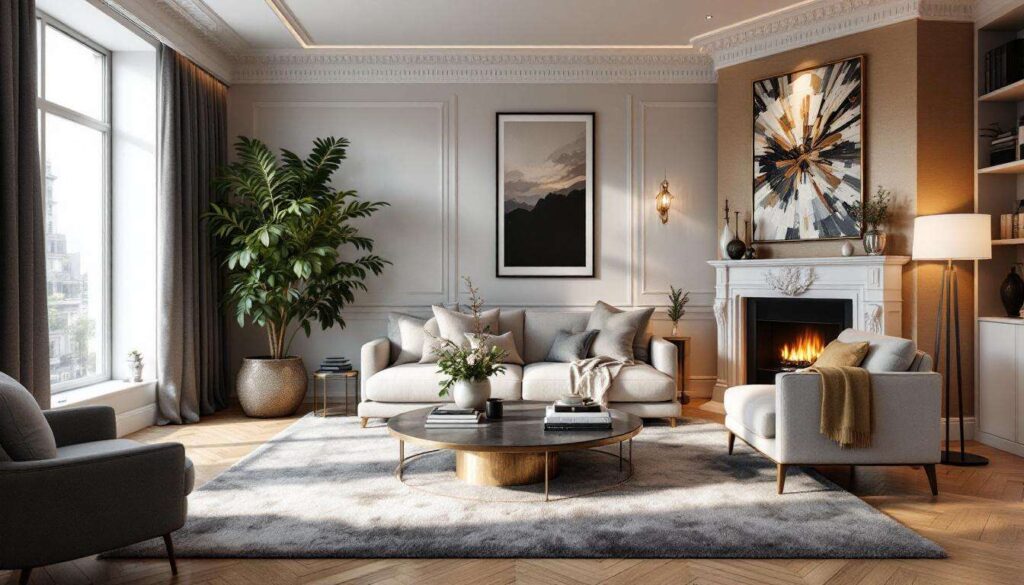
Creating a harmonious interior that feels neither too sparse nor overly cluttered has long challenged homeowners and decorators alike. The 345 decorating rule offers a straightforward framework for achieving visual balance in any room, regardless of size or style. This principle, quietly championed by interior designers across the United Kingdom, provides a mathematical approach to arranging decorative elements that naturally pleases the eye. Rather than relying on instinct alone, the rule establishes clear proportions for grouping accessories, artwork, and furniture in ways that create rhythm and cohesion. Understanding this concept can transform how you approach every space in your home, from mantlepieces to coffee tables.
Understanding the 345 decorating rule
The fundamental principle behind the numbers
The 345 decorating rule refers to grouping decorative objects in clusters of three, four, or five items to create visually appealing arrangements. These odd and even numbers work together to establish balance without symmetry, allowing the eye to move naturally across a display. The rule suggests that three items create intimacy, four items add stability, and five items bring complexity without overwhelming the viewer. Professional designers apply this principle when styling shelves, arranging cushions, selecting wall art, and positioning accessories throughout a room.
Why these specific numbers matter
The effectiveness of 3, 4, and 5 stems from principles rooted in visual perception and design theory. Consider the following advantages:
- Three creates a triangular composition that feels complete yet dynamic
- Four establishes symmetry and grounding, particularly useful for larger furniture arrangements
- Five introduces variety whilst maintaining cohesion, perfect for more elaborate displays
- These quantities prevent both the starkness of pairs and the chaos of excessive groupings
The rule provides flexibility for different aesthetic preferences whilst maintaining underlying structure. Whether your style leans towards minimalism or maximalism, these groupings adapt beautifully. This mathematical foundation explains why the principle has gained traction among designers seeking reliable methods for creating balanced interiors.
Why British designers embrace it
Practical solutions for varied British homes
UK properties present unique decorating challenges, from compact Victorian terraces to sprawling Georgian townhouses. The 345 rule offers scalable solutions that work regardless of room dimensions or architectural period. British designers appreciate how this principle addresses the eclectic nature of British interiors, where traditional and contemporary elements frequently coexist. The rule’s adaptability makes it particularly valuable in homes where space constraints demand thoughtful curation rather than abundant display.
Alignment with British design sensibilities
The understated elegance favoured in British design culture aligns perfectly with the 345 approach. Rather than creating overly styled or contrived arrangements, this method produces effortlessly composed spaces that appear naturally curated. The following characteristics resonate with British aesthetic values:
| Design Value | How 345 Rule Supports It |
|---|---|
| Restraint | Prevents over-accessorising whilst maintaining interest |
| Timelessness | Creates arrangements that transcend fleeting trends |
| Practicality | Offers clear guidelines without rigid prescriptions |
| Individuality | Allows personal expression within structured framework |
This mathematical approach provides the structure that many homeowners crave when attempting to replicate the polished look of professionally designed spaces. Beyond aesthetics, the principle addresses how British designers balance functionality with beauty in everyday living environments.
Secrets to a balanced room with the 345 rule
Creating visual weight distribution
Achieving balance requires more than simply counting objects. Visual weight considers colour, texture, scale, and positioning when applying the 345 rule. A large statement piece might count as the equivalent of two or three smaller items in terms of visual impact. Designers recommend varying heights within groupings to create dynamic compositions that draw the eye upward and across surfaces. The tallest item typically anchors one end, with medium and shorter pieces creating a descending rhythm that feels intentional rather than accidental.
Layering with purpose
Successful application of the 345 rule involves thoughtful layering that adds depth without clutter. Consider these layering strategies:
- Position larger items at the back, graduating smaller pieces forward
- Overlap frames and objects slightly to create connection between elements
- Incorporate varied textures within your groups to add tactile interest
- Use negative space deliberately, allowing breathing room between clusters
- Repeat colours or materials across different groupings to unify the room
Balancing symmetry and asymmetry
The 345 rule excels at creating asymmetrical balance, where visual weight feels evenly distributed without mirror-image arrangements. On a mantelpiece, three candlesticks on one side might balance four smaller objects grouped on the opposite end. This approach feels more relaxed and contemporary than rigid symmetry whilst maintaining the order necessary for cohesive design. Understanding these balancing techniques prepares you to implement the rule effectively throughout your own space.
How to apply the 345 rule at home
Starting with coffee table styling
Coffee tables provide an ideal practice ground for mastering the 345 principle. Begin with three items: perhaps a stack of books, a decorative bowl, and a small plant or candle. Vary the heights and ensure each item serves either a functional or aesthetic purpose. For larger coffee tables, expand to five items by adding a tray to corral smaller objects and a sculptural element for visual interest. The key lies in editing ruthlessly, removing anything that doesn’t contribute to the overall composition.
Arranging shelving and bookcases
Open shelving benefits enormously from the 345 approach. Rather than filling every shelf uniformly, create intentional groupings that allow the eye to rest. Consider the following arrangement strategy:
- Dedicate some shelves to groups of three larger items
- Use four items on mid-level shelves to create stability
- Arrange five smaller objects on higher shelves for visual interest
- Alternate between book stacks and decorative groupings
- Leave some shelves relatively sparse to prevent visual overwhelm
Styling walls and artwork
Gallery walls exemplify the 345 rule beautifully. A three-frame arrangement works perfectly above a sofa or bed, whilst five frames create a more complex composition suitable for larger walls. Four frames arranged in a grid provide symmetry and formality, ideal for traditional spaces. When hanging artwork, maintain consistent spacing between frames and consider the grouping as a single unit rather than individual pieces. This systematic approach transforms decorating from guesswork into an achievable process with predictable, professional results.
Common mistakes to avoid with the 345 rule
Ignoring scale and proportion
The most frequent error involves selecting items without considering their relative sizes. Three tiny objects on a large console table will appear lost, just as five oversized pieces will overwhelm a small side table. Scale must correspond to the surface or wall you’re decorating. A useful guideline suggests that grouped items should occupy roughly two-thirds of the available surface, leaving adequate negative space. Professional designers always step back to assess whether the arrangement feels proportionate to its surroundings.
Creating monotonous groupings
Another pitfall involves selecting items that are too similar in height, colour, or style. Effective 345 groupings require variety to maintain interest. Common monotony mistakes include:
- Choosing all items in the same colour family without tonal variation
- Using identical heights, creating a flat, uninspiring line
- Selecting pieces with the same texture or material throughout
- Failing to include both functional and purely decorative elements
Overcomplicating the principle
Some decorators mistakenly believe every surface requires strict adherence to 3, 4, or 5 items. The rule serves as a guideline rather than an inflexible mandate. A single statement piece can stand alone when it possesses sufficient visual weight. Likewise, a collection of seven or nine items might work for larger installations when subdivided into smaller 345 groupings. The goal remains creating balance and visual interest, not rigidly counting objects. Understanding when to bend the rules distinguishes confident decorators from those mechanically following formulas.
Inspirational examples of the 345 rule in action
Classic British sitting rooms
Traditional British sitting rooms demonstrate the 345 rule through carefully curated mantlepiece displays. A typical arrangement might feature a central mirror flanked by three candlesticks on one side and four smaller objects on the other. Coffee tables often showcase five items: a large decorative book, a small tray with coasters, a plant, a candle, and a sculptural object. These seemingly effortless compositions result from deliberate application of the principle, creating rooms that feel both lived-in and polished.
Contemporary minimalist spaces
Modern British interiors use the 345 rule with restraint, often favouring groups of three to maintain clean lines. A minimalist bedroom might display three framed prints above the bed, three cushions arranged on the duvet, and three objects on the bedside table. The repetition of three throughout creates cohesion through consistency whilst the careful selection of each item prevents the space from feeling sparse. This approach proves that the rule adapts beautifully to various aesthetic preferences.
Eclectic maximalist designs
Even pattern-rich, colour-saturated interiors benefit from the 345 structure. Maximalist spaces might feature five cushions on a sofa, four pieces of artwork in a gallery wall section, and three decorative objects on floating shelves. The rule provides underlying order that prevents these busy spaces from descending into chaos. By maintaining consistent grouping principles throughout, even the most eclectic rooms achieve the balance necessary for visual comfort and aesthetic success.
The 345 decorating rule provides an accessible framework for creating professionally styled interiors without formal design training. By grouping objects in clusters of three, four, or five, you establish visual rhythm and balance that naturally pleases the eye. British designers favour this approach for its flexibility, adaptability to various spaces, and alignment with understated elegance. Whether styling a coffee table, arranging shelving, or hanging artwork, the principle offers clear guidance whilst allowing personal expression. Avoiding common mistakes like ignoring scale or creating monotonous groupings ensures successful implementation. From traditional sitting rooms to contemporary minimalist spaces, the 345 rule proves its versatility across aesthetic styles, transforming ordinary rooms into harmonious, thoughtfully composed environments that reflect both structure and individuality.