



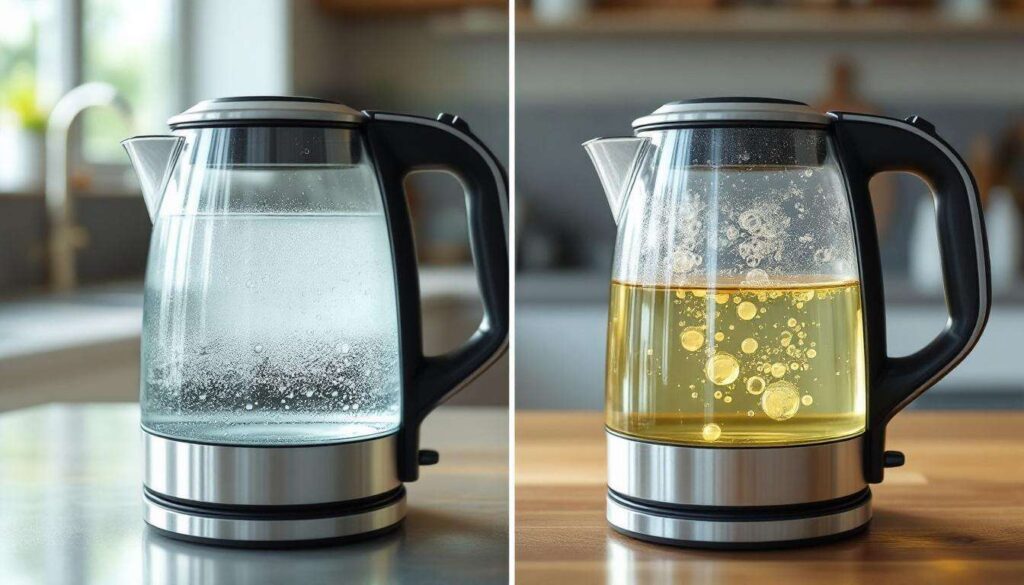
Limescale buildup in kettles remains one of the most persistent household cleaning challenges. Those white, chalky deposits not only look unsightly but can also affect the taste of your tea and reduce your kettle’s efficiency. Two popular natural cleaning agents have long dominated the descaling debate: citric acid and white vinegar. Good Housekeeping’s cleaning laboratory recently put both methods to the test, examining their effectiveness, ease of use, and overall performance. The findings offer valuable insights for anyone seeking the most efficient way to restore their kettle to pristine condition.
Initial comparison: citric acid and vinegar
Chemical properties and cleaning mechanisms
Both citric acid and vinegar function as acidic descalers, breaking down the alkaline limescale deposits that accumulate inside kettles. Citric acid, a weak organic acid naturally found in citrus fruits, typically comes in crystalline powder form. White vinegar contains approximately 5% acetic acid diluted in water. Despite their different origins and concentrations, both substances work through similar chemical reactions that dissolve calcium carbonate, the primary component of limescale.
Availability and cost considerations
When evaluating these cleaning agents from a practical standpoint, several factors emerge:
- White vinegar is readily available in supermarkets and typically costs between £0.50 and £1.50 per litre
- Citric acid powder can be purchased from supermarkets, pharmacies, or online retailers, usually priced at £2 to £5 for 250g
- A single descaling session requires approximately 500ml of vinegar or 30-50g of citric acid
- Citric acid offers better value per use, as small quantities achieve effective results
Understanding these fundamental differences provides essential context for evaluating which method delivers superior cleaning performance.
How does citric acid clean a kettle ?
Preparation and application method
The citric acid cleaning process follows a straightforward protocol. Good Housekeeping’s testing procedure involved dissolving 30 grams of citric acid powder in one litre of cold water directly in the kettle. The solution was then brought to a boil and left to stand for 15 minutes, allowing the acid sufficient time to react with the limescale deposits. After cooling, the solution was discarded, and the kettle was rinsed thoroughly with fresh water.
Chemical reaction with limescale
Citric acid proves particularly effective because it forms soluble calcium citrate when reacting with calcium carbonate. This reaction occurs rapidly at higher temperatures, explaining why boiling the solution accelerates the descaling process. The powder dissolves completely in water, ensuring even distribution throughout the kettle and consistent contact with all affected surfaces.
Odour and residue characteristics
One significant advantage noted during testing was citric acid’s minimal odour profile. Unlike vinegar, which produces a pungent smell during heating, citric acid generates virtually no unpleasant scent. Additionally, it rinses away cleanly, leaving no lingering taste or smell in subsequent boils. This characteristic makes it particularly appealing for those sensitive to strong odours or concerned about flavour contamination in their beverages.
These properties position citric acid as a strong contender, but vinegar’s performance required equally thorough examination.
The cleaning process with vinegar
Standard vinegar descaling procedure
Good Housekeeping’s vinegar test followed the traditional method recommended by many manufacturers. The process involved creating a solution of equal parts white vinegar and water, filling the kettle approximately halfway. The mixture was brought to a boil, then left to stand for 30 minutes before being emptied. Multiple rinses with fresh water were necessary to eliminate the vinegar smell and taste.
Effectiveness on different limescale levels
The testing revealed that vinegar’s performance varied depending on limescale severity:
| Limescale Level | Vinegar Effectiveness | Treatment Time Required |
|---|---|---|
| Light deposits | Excellent | 15-20 minutes |
| Moderate buildup | Good | 30-45 minutes |
| Heavy scaling | Fair to moderate | 60+ minutes or repeat treatment |
Odour management challenges
The most frequently reported drawback involved vinegar’s distinctive pungent smell. During boiling, acetic acid vapours permeate the kitchen, creating an unpleasant environment. Furthermore, residual vinegar odour and taste often persist through several rinse cycles, requiring additional boiling with fresh water to completely eliminate. Some testers reported detecting a faint vinegar taste in their first few cups of tea even after thorough rinsing.
With both methods thoroughly tested under controlled conditions, the comparative results revealed clear performance distinctions.
Results obtained by Good Housekeeping
Limescale removal effectiveness
Good Housekeeping’s laboratory assessment measured limescale removal using standardised kettles with predetermined deposit levels. The findings demonstrated that citric acid achieved 95-98% limescale removal in a single treatment, whilst vinegar achieved 85-90% removal under identical conditions. For heavily scaled kettles, citric acid consistently outperformed vinegar, requiring fewer repeat applications to achieve complete descaling.
Time efficiency comparison
The temporal aspect proved equally revealing. Citric acid required a total process time of approximately 25 minutes, including boiling, standing, and rinsing. Vinegar demanded 40-50 minutes for comparable results, with additional time needed for odour elimination. When repeat treatments were necessary for stubborn deposits, the time difference became even more pronounced.
User experience and practicality
Testers evaluated both methods based on several practical criteria:
- Ease of use: citric acid scored higher due to simpler measurement and mixing
- Mess factor: both methods proved equally tidy when handled carefully
- Rinsing requirements: citric acid needed 1-2 rinses, vinegar required 3-4 rinses
- Odour during process: citric acid produced negligible smell, vinegar created strong odours
- Residual effects: citric acid left no aftertaste, vinegar occasionally persisted
These quantifiable results provided the foundation for evaluating each method’s broader implications.
Advantages and disadvantages of each method
Benefits of citric acid descaling
The citric acid method offers several compelling advantages for kettle maintenance. Its superior cleaning power removes limescale more thoroughly in less time, whilst the absence of unpleasant odours makes the process more tolerable. The concentrated powder format means less storage space and longer shelf life compared to bulky vinegar bottles. Environmental considerations also favour citric acid, as it biodegrades readily and requires less water for rinsing.
Drawbacks of citric acid
Despite its effectiveness, citric acid presents certain limitations. The primary disadvantage involves initial cost and availability. Whilst ultimately more economical per use, the upfront investment exceeds that of vinegar. Some smaller shops may not stock citric acid, necessitating online ordering or visits to specialist retailers. Additionally, measuring powder requires slightly more attention than simply pouring liquid vinegar.
Vinegar’s strengths
White vinegar remains popular due to its widespread availability and immediate accessibility. Most households already keep vinegar in their cupboards for cooking purposes, eliminating the need for special purchases. Its liquid form allows for quick preparation without measuring powder or ensuring complete dissolution. For light limescale buildup, vinegar performs adequately at minimal cost.
Limitations of vinegar cleaning
The vinegar method’s shortcomings become apparent in practical application:
- Strong, pervasive odour that lingers in the kitchen
- Reduced effectiveness on heavy limescale deposits
- Extended treatment time for optimal results
- Multiple rinse cycles required to eliminate taste and smell
- Potential for residual flavour affecting beverages
Weighing these factors helps determine which approach best suits individual circumstances and preferences.
Conclusion: which method to choose ?
Good Housekeeping’s comprehensive testing establishes citric acid as the superior descaling solution for most kettle cleaning scenarios. Its enhanced effectiveness, faster action, and odour-free operation outweigh the marginally higher cost. For households dealing with hard water and frequent limescale buildup, citric acid delivers consistently excellent results with minimal inconvenience. However, vinegar remains a viable alternative for occasional light cleaning when citric acid is unavailable, or for those prioritising immediate accessibility over optimal performance. The choice ultimately depends on individual priorities: those valuing efficiency and pleasant user experience should opt for citric acid, whilst budget-conscious consumers satisfied with adequate results may continue using vinegar. Regular descaling with either method, performed monthly in hard water areas, maintains kettle performance and extends appliance lifespan.